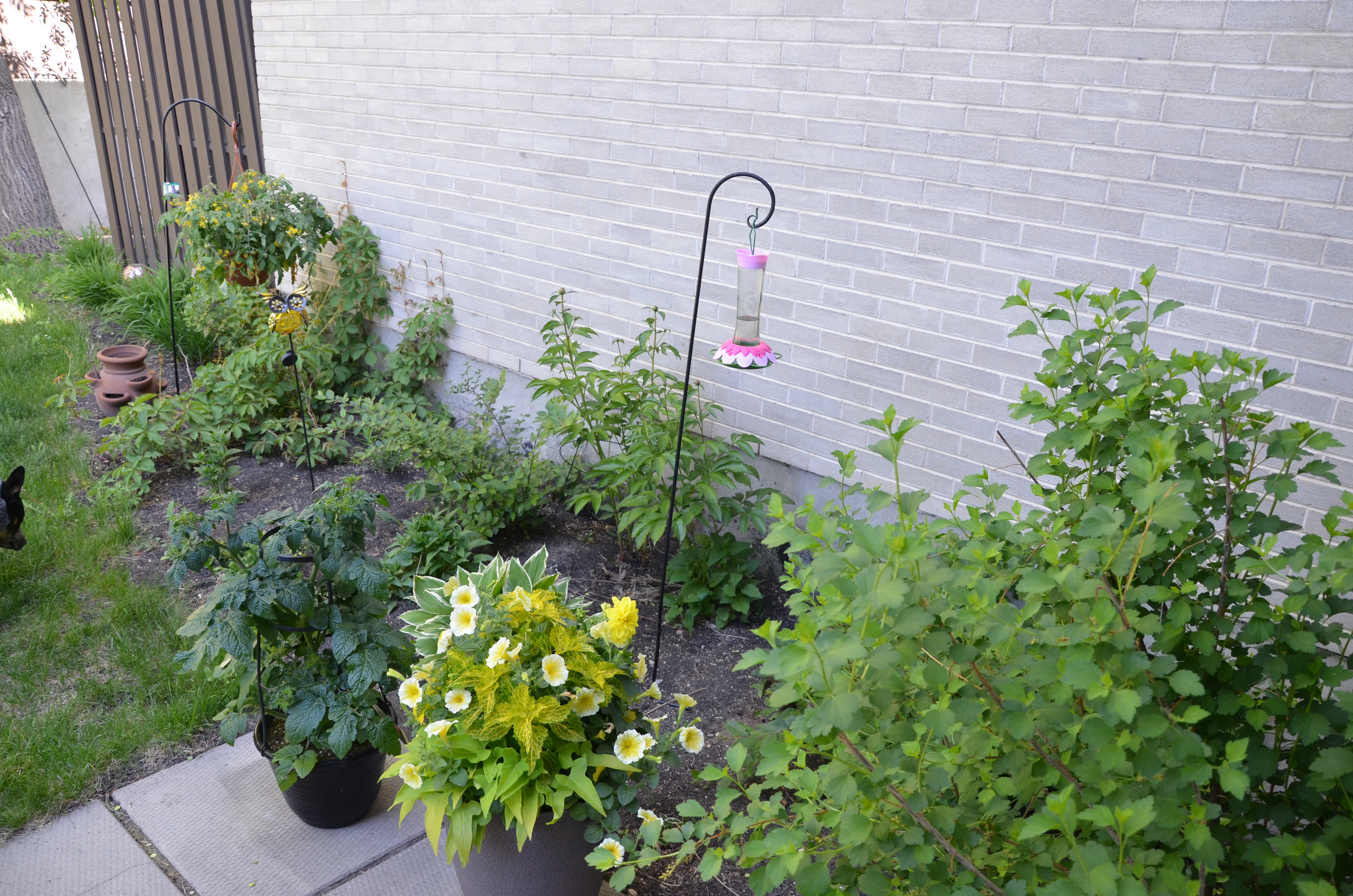
I asked for and received a new hummingbird feeder for my birthday.
The birds at home always made their return appearances near the May long weekend, sometimes a bit before, sometimes a bit after. I imagine they are there now and the new owners are feeding them.
I put out the new feeder in the small patch of garden we now own. So far, no luck. But I shall persevere. All I need is one to find it. If that happens, I will be guaranteed hummingbirds from year to year.
I live in hope.
+++++++++
At home on the farm we used to barbecue a lot, year-round when winter weather permitted it. To be accurate, K barbecued. I ate the fruit of his labours.
We left the old barbecue behind when we moved. It had passed its prime and we were not sure whether it would make the move without coming to pieces.
Recently we purchased a new barbecue and christened it with an evening meal. Steak, baby potatoes and asparagus. In the old days, it would have been homegrown beef and the asparagus would have been wild asparagus picked in neighbourhood ditches. This time the steaks came from a meat shop and the asparagus from a farmer’s market.
It tasted like home, but our tastes are more expensive than they used to be.
++++++
My name has two ‘r’s, something that people often ask about and spellers often get wrong.
I don’t have a lot of stories in my repertoire, but this is one of them: the story of how I got my name.
My mother graduated from high school at sixteen and then had to wait two years until she was eligible to attend teachers college, or Normal School as it was called then. According to Wikipedia, a normal school is the historical term for an institution created to train high school graduates to become teachers by educating them in the norms of pedagogy and curriculum. Hence the ‘norm’ in ‘normal’ school.
The one-room schoolhouse she had herself attended was between teachers and my mother was hired as a ‘permit teacher’. The practice of hiring unqualified teenagers began during World War 2 when many qualified teachers had joined the Armed Forces. It continued until the 1960s mostly in rural schools; my school had a permit teacher when I was in Grade 5.
Most permit teachers only taught for one year; my mother taught at her local school for two years.
A young woman in the community had a preschool-age daughter. For some reason, her husband was out of the picture and the woman needed to work to support herself and the little girl. This was long before the days of child care and the woman had no family in the community.
The local school board agreed that the child could attend the school even though she was too young and would therefore be cared for during school hours at least.
The girl’s name was Sharron, with two ‘r’s and my mother became fond of her over those two years.
“If I have a little girl, I am going to call her “Sharron”, my mom said.
The story has always seemed important to me for two reasons.
First of all, it is a story about how small rural communities can make things work for their citizens. It is one of their strengths. And since I have been a rural dweller and an advocate for the benefits of country living for many years, I can relate to that.
Reason number two is this:
For approximately thirty years now, my work has been connected to early child development, parent-child relationships and early literacy. I never started out thinking that I would spend so much time working with children and families. My original training was in something quite different, although literacy has always been a passion of mine.
But I wouldn’t have my name if it weren’t for a community doing what it could to support a mother and her child.
Probably because I am now within days of retirement, the story resonates with me even more than usual.
-30-
 Rural Routes, Blog Version
Leave a comment