I wrote this essay six months ago when the pandemic of 2020 was only a couple of months old. It remains accurate, although the ensuing months have taken their toll. COVID has found its way to rural areas; isolation, while a protection of sorts, is not immunity.
The 2020 COVID-19 pandemic has made me homesick for the farm.
In 2018, my husband and I sold our home quarter in rural Manitoba and moved to Winnipeg, where our adult children live.
If we were still on the farm, we could spend a great deal of time outdoors without seeing another human being. Physical distancing is a fact of life in rural Canada, not a public health edict. Life might seem more normal, rather than feeling like an endless cycle of Groundhog Days.
If I am honest, though, the virus and its impacts have accentuated my nostalgia, but the emotions were already there.
Both my husband and I lived most of our lives in the community where we were born and raised. The farm had been our way of life since our marriage in 1978. Our children represented the fourth and fifth generations in families that came to Canada from the British Isles and Iceland.
There are benefits to living in a city. We get our mail delivered daily and our garbage picked up on a regular basis. We finally have dependable cell phone and Internet service. A five-minute walk takes us to a post office, a pharmacy, two grocery stores, an optometrist, and a dentist. We can order in if we don’t feel like cooking. And the nearest hospital is just across a side-street; we could crawl there if we had to, my husband says. None of these benefits have been erased by pandemic measures, although we live with new restrictions.
We have discovered that there is no shortage of wildlife in the city. Since putting out a birdfeeder, we have become popular with the neighbourhood squirrels (both the little red variety we saw on the farm and larger gray ones as well) and several rabbits. We have not seen any raccoons yet, but the condo management has asked us not to put our garbage bags outside because of them, so they must be there. There are deer in the former golf course adjacent to the property. Twice last fall while walking our dog, I came upon a skunk. (It is not as if I hadn’t been up close and personal with a skunk before, but it was not something I anticipated in Winnipeg.)
But there are no cattle in the city. We cannot delight in new calves finding their legs in the early spring. We cannot enjoy the sight of cows and their calves in summer pastures. We sold the bulk of our cattle herd in 2010, retaining about ten animals that were personal favourites. Within a few years, the herd had grown to twenty-five. That’s what happens when you don’t sell the bull. These animals were eventually purchased by a rancher who rented our excess pasture and for several years, he brought these same cattle back to pasture each summer. It was rather like having the grandchildren come to visit. The animals remembered the place and we could enjoy them for the summer, then send them back with their new owner for the winter.
I also miss the barn cats, not quite feral, not quite tame. When we no longer used the barn, they began coming to our deck. I fed them regularly and gave them names. The last of them disappeared the last summer we were home; we blamed a new dog in the neighbourhood, and I was sorry to see them go. Yet I was glad that they were no longer around when it was time for us to move; I would have worried about them.
I think, though, that what I miss the most are the trees and shrubs. We do have three full-grown trees in the common area outside our back door in the city and we are fortunate to live in an area of the city where there are many trees. Some of them unfortunately wear the red band of death that signifies a diagnosis of Dutch Elm Disease. It is not trees generically that I miss; it is the particular trees that framed the landscape of our yard at the farm.
For example, there was a line of weeping birch trees at the western edge of the yard. The seedlings were given to us by friends of my in-law’s; they helped us plant them one sunny fall afternoon many years ago.
The local municipality used to get trees annually from Indian Head, SK, before the nursery there was closed. One year, when the supply exceeded municipal needs, the trees were made available to community residents on a first-come first-served basis. We got Scots pine and tamaracks and planted them in the yard. The instructions provided with the Scots pine said that the trees were best planted with more mature trees, which would give the conifers shelter during their early years. In time, the leaflet said, the pines would dwarf the trees around it.
Each year as the snow melted and the ground appeared again, my children and I would walk through the bush looking for those pine trees. In the height of summer, they were invisible against the green of other foliage. In early spring, however, their green needles were easily spotted. We played “Where’s Waldo?” where Waldo was a small evergreen hidden in the grays and browns of early spring.
Saskatoon shrubs edged the bush around our farmyard. In years when there was no killing frost at a crucial time in their development, I could run outside to gather a few cups for a pie. There were two puny lilac shrubs that, despite my best efforts, never quite managed to grow tall, although they did bloom. It could have something to do with the person manning the lawn mower when they were small, or the snowplow in the winter. Not to mention the healthy rosy bloom crab in the front yard, gifted to us when my mother died in 2007. It was covered in pinkish purple blossoms in the spring and bright red berries for the birds in the fall.
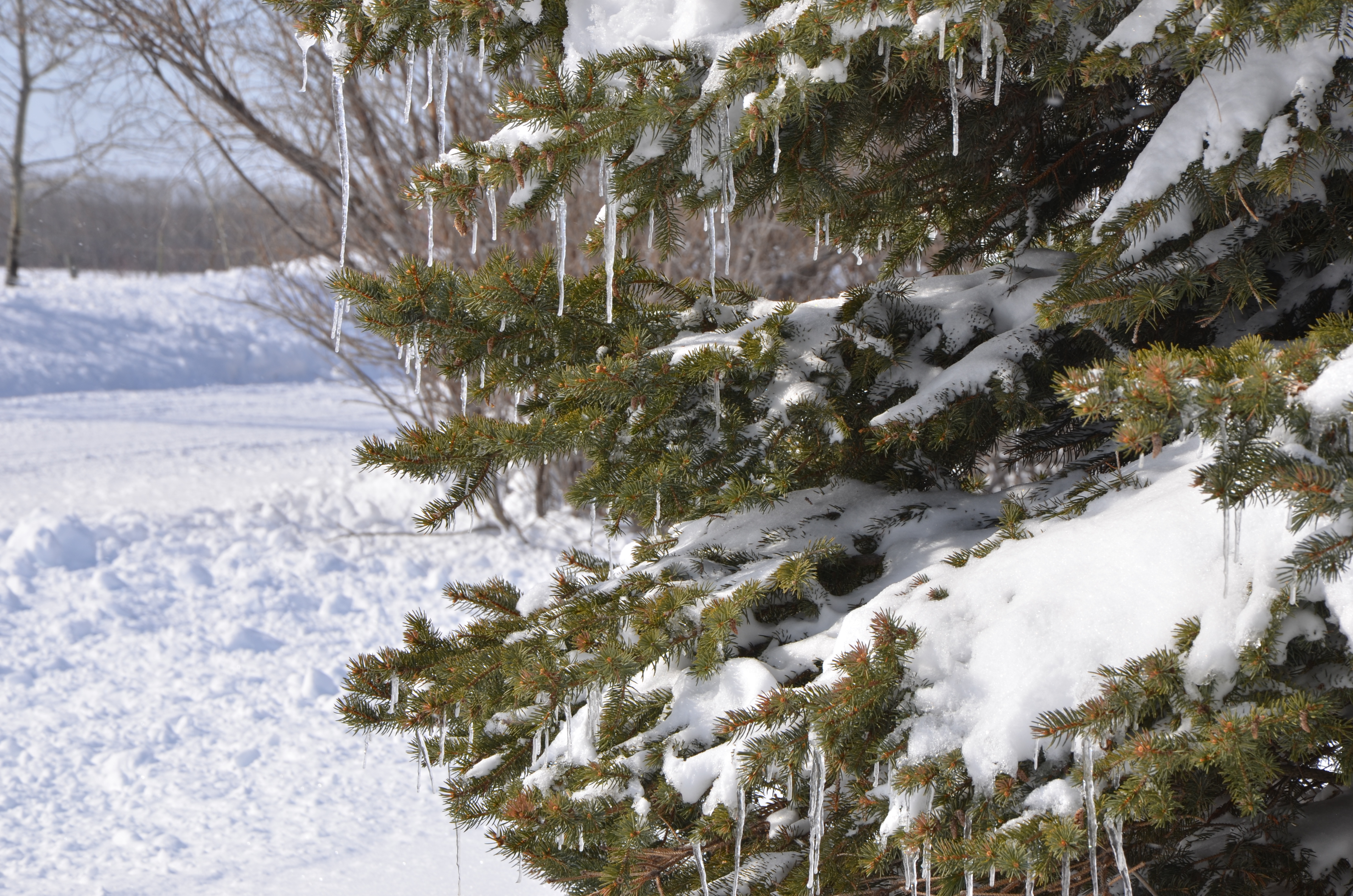
When our youngest child was still a pre-schooler, my father-in-law planted a small spruce tree in our front yard. He dug the tree from a spot less than a mile away where his own grandfather had planted the initial evergreens that grace the highway right-of-way.
At first, our children were taller than the little tree. As time went on, the tree eclipsed them. We would cautiously venture near in spring to spot the telltale turquoise of robin’s eggs in nests hidden in the branches. I wound Christmas tree lights from bottom to top.
The tree grew. Our dogs rested in the shade it provided. One string of lights was no longer enough at Christmas time. Eventually, the only way I could have reached the top of the tree was by standing in a tractor’s raised front end loader. I was not that committed to the cause and no longer put up the holiday lights.
The tree was there whenever I looked out the living room window. I called it my Christmas tree for all seasons.
Perhaps it is not surprising that I would miss these green things, symbols as they are of growth and seasons and the changes wrought by time. They remind me, too, of roots: how long it takes to set them down, how deep and wide they grow underground and undetected, and how painful it can be to dig them up.
-30-

 Rural Routes, Blog Version
Leave a comment