A friend recently told me that she was going on a diet. Her psyche was weighed down these days, she said, so she was going to limit her reading to library books and the lifestyle section of the newspaper. Salad and dessert, she said. No main courses.
I understand her rationale perfectly.
Public School Curriculum and Teachers’ Guide Grades 1-VIII – Department of Education, Province of Saskatchewan, 1931

Since the pandemic began, K and I have gotten into the habit every weekend of watching an online auction sale from Prince Albert, SK. Watching, and occasionally bidding.
(I think that when K and I go travelling again, we might drive to Saskatchewan to attend one of these weekly sales in person. We know the voices; it would be nice to see the faces.)
This book was one of our purchases.
It was a new curriculum apparently. “The curriculum is still in the making and teachers will be given every opportunity to assist in its refinement.”
One paragraph in the Foreword caught my attention:
“Teachers are requested to concentrate upon the final objectives, namely, health and happiness, social efficiency and the use of leisure for the enrichment of life. The emphasis is not to be placed upon subjects of study, but upon child welfare. The spirit of the curriculum is more important than the details of the subjects prescribed.”
The Grade 7 Social Studies curriculum includes a section on citizenship – the rights of the citizen and the duties that accompany those rights. For example, we have freedom of speech and freedom of the press, provided there is no infringement of the rights of others.
Under the Code of Good Citizenship, questions asked include: Do I try to follow the rules of health? Do I always respect the rights of others? Do I use but not abuse public property?
Interesting questions, both in 1931 when they were written and now 91 years later.
Winterkill – Ragnar Jonasson
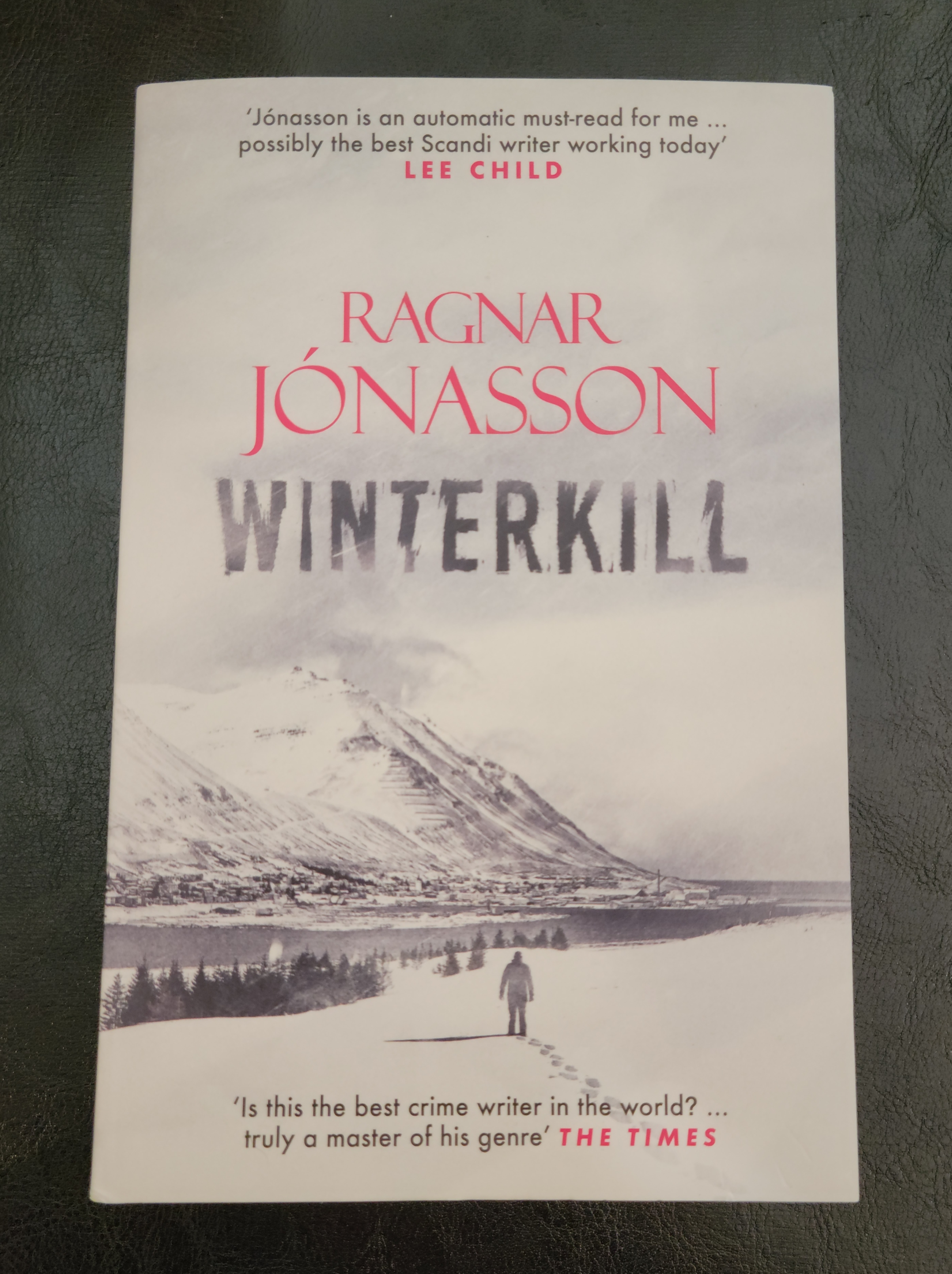
Winterkill is the sixth in Jonasson’s dark Iceland Scandi noir crime volumes.
I like the fact that the stories take place in Siglufjordur, the northernmost town in Iceland. M and I visited the town when we went to Iceland in 2014. We toured the herring museum, ate a waffle at an outdoor restaurant, drove through a claustrophobia-inducing tunnel to get there. I can visualize the town’s setting as I turn the pages.
In this book, there was an added bonus. One of the characters planned to visit Siglunes. Not the Siglunes in Iceland. No, the Siglunes in Manitoba.
Technically, I am not sure it exists, at least not anymore. But it is the area of the province where my mother was raised, on the eastern side of Lake Manitoba near The Narrows. It was a rural municipality until it amalgamated with Eriksdale to become the RM of West Interlake in 2015.
The character in the book comments that he has heard its name has been changed. I am not sure whether he is referring to the municipal amalgamation or something else.
Composition Book – author unknown, unfinished
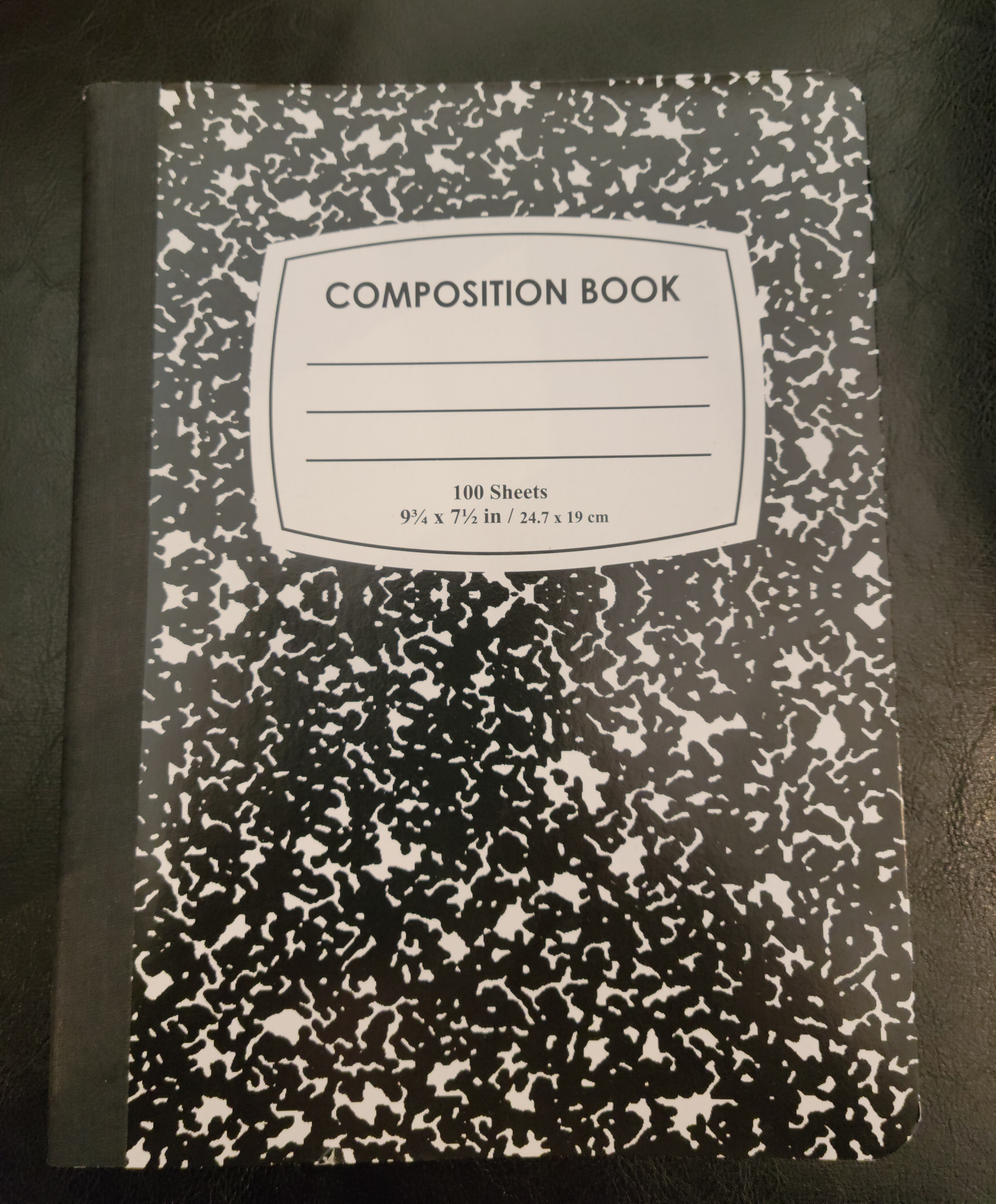
This one is courtesy of the local dollar store.
There it was on the shelf – “Composition Book”, the front cover said, and, in my mind, I went back to one-room schools where English Composition was studied and sentences were parsed.
I never used a Composition Book, at least not one that advertised itself as such on the front cover. I was more familiar with scribblers, binders, and loose leaf.
But my research tells me that composition books have been around since the mid-1800s. The cardboard cover with a black marble design is unique. Each composition book is 7.5 inches by 9.75 inches. It has 100 pages and is lined with blue ink.
Some companies have adopted their own brand of composition books. You can purchase more expensive versions if you wish, but cheaper paper quality was a characteristic of the original brand. That could explain why I found it in a dollar store.
It must be true that a woman and her $1.25 are soon parted, because I came home with a brand-new composition book, just waiting to be filled.
The Anthropocene Reviewed – John Green
I borrowed this from one my adult children. I had seen articles and reviews about the book and wanted to read it for myself.
Anthropocene refers to the geological age in which we live, commonly considered to be the one in which humans have had the greatest impact on climate and the environment.
In the book, Green takes a look at everything from the QWERTY keyboard and Icelandic hot dogs to Canada geese and Auld Lang Syne.
I found it best to read one essay at a time, letting it percolate over a few hours before starting a new one. I thought some of the essays were brilliant, others not quite so.
I do believe that Canada Geese deserve more than one star.
And I have trouble with the concept of assigning a number rating to anything creative or literary or artistic. I do not believe that anything could rate a 0 and neither do I believe that there is such a thing as perfection. If I give a book a 5/5, it is because it took me both inside and outside myself simultaneously for chapters at a time. That is magic and worth a perfect score.
Most of the time, I struggle with assigning a whole number to a book. It’s not quite a four; more like a 3.8. So, I’ll round it up to 4, even though that is not exactly accurate.
-30-
 Rural Routes, Blog Version
Leave a comment