Often when we sit outside, we look up to the sound of an airplane flying overhead. It seems we are on the flight path for passengers travelling east.
A month ago, I flew to Ontario to visit a friend I had not seen for 20 years. Flying over the city, I recognized a landmark not far from where we live.
Could I see our townhouse? I craned my neck to look closer. And yes, there it was, not the townhouse itself, but definitely the row of attached townhouses. Looking down from above, it was impossible to tell where one unit ended and the next began.
For the first time in my life, I was flying directly over my home. I have sat in my yard looking up at an airplane and I have sat in a plane looking down at my yard.
A small thing, but something to remember about the trip.
Enjoy the little things, for one day you may look back and realize they were the big things.” Robert Brault, often misattributed to Kurt Vonnegut
ICELAND’S ELVES
I recently read “Looking for the Hidden Folk: How Iceland’s Elves Can Save the Earth” by Nancy Marie Brown.
I don’t come down on either side of the ‘do elves exist’ debate if there is such a thing. I never saw an elf on my one trip to Iceland. Yet I am a strong believer in Hamlet’s “there are more things in heaven and earth”. There is much we do not know.
Brown talks a lot about wonder, that state of awe that in my working life I often heard described as a childhood trait that is lost as we age.
Brown argues that adults need wonder in their lives and says that in olden times, before the advent of science and technology, wonder connected people to nature in a way that no longer exists.
She also talks about the shape of life and how that shape differs in human and natural worlds. Human stories are linear, she says; there is a beginning and an end. The Bible, for example, begins with creation and ends with an apocalypse.
The natural world, on the other hand, is circular. Summer follows spring which follows winter which follows winter which follows summer.
Elves are a connection between the two worlds.
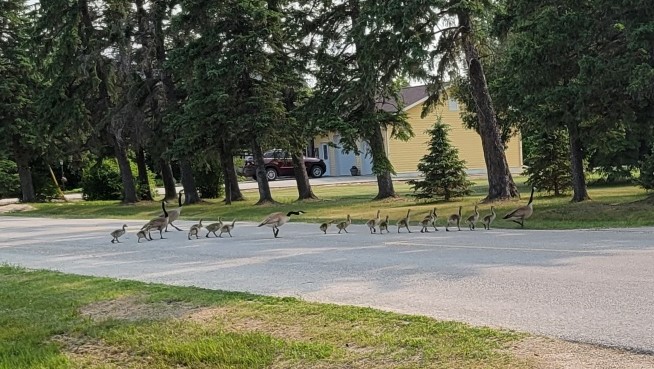
RACCOON
Earlier this spring, a raccoon had been sighted on the rooves of townhouses in our complex and professionals were hired to trap the critter.
We had twice seen a raccoon in our back yard last fall, but after that, nothing. It might be the same raccoon, or it might not.
At any event, we waited to hear that the animal had been caught. Weeks went by with no word.
Eventually though, we were notified that Operation Raccoon had been successfully completed.
It seems that the trappers had to change their tactics when the sardines they used as bait failed to entice the raccoon into the trap. (Personally, I don’t blame them. The scent of sardines sends me in the opposite direction, too.)
So, what did they use instead of sardines?
A two-piece KFC chicken meal.
The fast-food meal of choice for city raccoons.
“It has long been an axiom of mine that the little things are infinitely the most important.” — Arthur Conan Doyle “
WHO DARE TO LIVE
The book I am now reading was purchased last winter at a going out of business sale for a local used bookstore.
The novel tells the story of an English widow living in Germany with her young daughter during the Second World War.
It was written by Ruth Lucas, who spent the war years in Hampshire tending the farm while her husband was overseas. She wrote the book and then put it in a drawer, where it sat for twenty years.
“Who Dare to Live” was published in 1965.
I am intrigued. How did the novel get published after so much time? Was it the author herself who decided to bring it to the attention of possible publishers? Was it a family member? Child? Sister? And were there changes made to the book twenty years later to reflect what had been historically proven about life in Germany at the time? Or did the author get it right the first time?
I have done some research, but so far have not been able to find the answers to my questions. I shall keep trying.
One thing I did learn: The price listed on the flyleaf of the book is $4.95. The price entered in pencil at the bookstore was $7 and I purchased the book for $1. An online used bookstore wants $100 U.S. for this book, plus postage.
Live life like it’s the last breath you take for that breath is the whole essence of living, the little things in life are what connects us to all the big things we live for.”
Robert Frost
CROCODILES AND SCHOOL GIRLS
In another book, set in Scotland in the years immediately following World War One, I read about a crocodile of schoolgirls passing by.
The phrase intrigued me enough to do an internet search. A crocodile of school children was the British term used for a group of school children walking in pairs, accompanied by one or two adults as chaperones.
The name supposedly came from the side-to-side waving motion of the formation as it passed.
Nowadays they call this a walking school bus, and that is a term I have heard.
TOTES
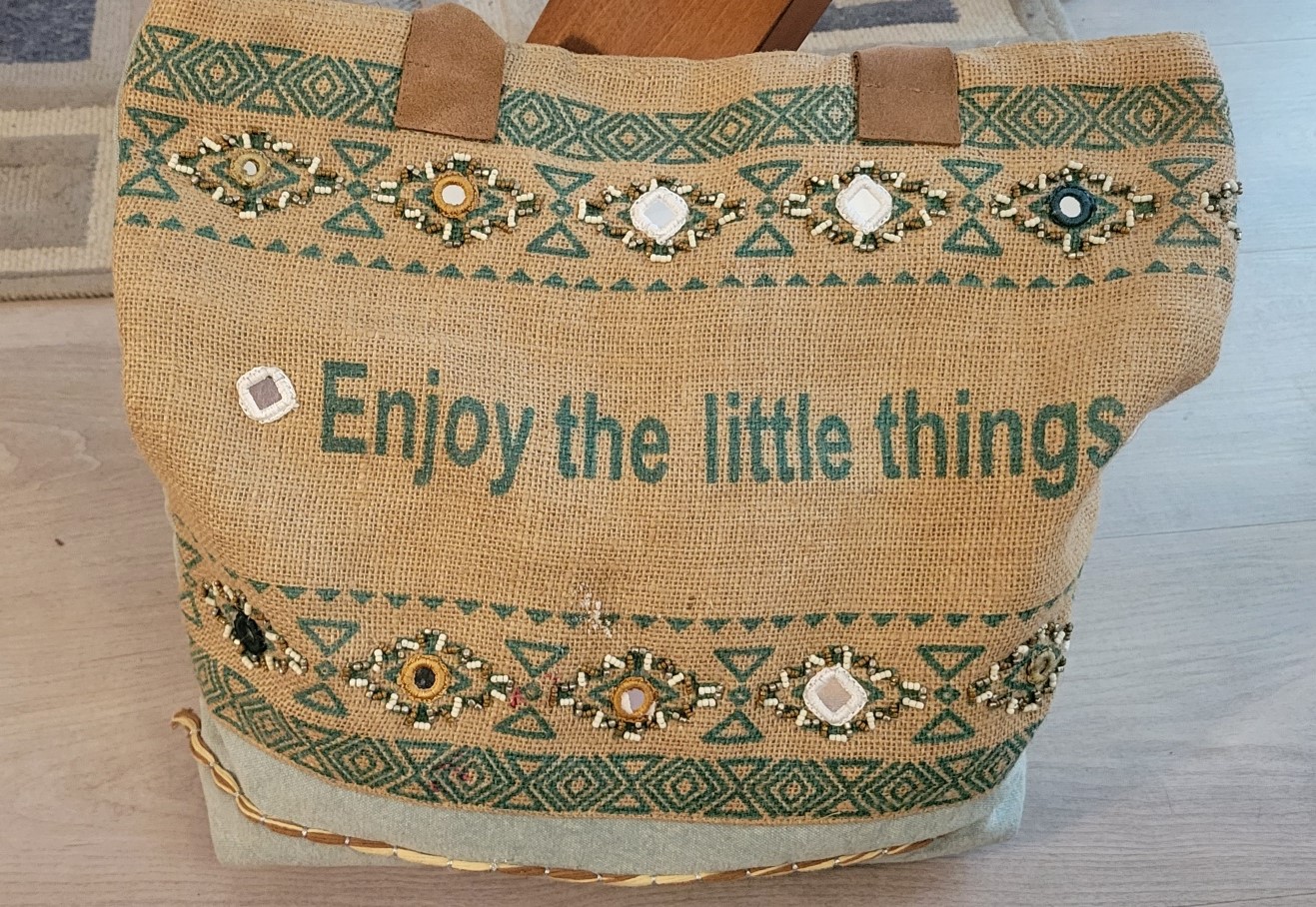
The tote bag I am carrying around this summer features the words “Enjoy the little things” on its front.
K thinks this is amusing because the bag itself is not a little thing.
He makes a valid point.
But I need a large tote to carry all the many little things inside it.
-30-
 Rural Routes, Blog Version
Leave a comment